Deutsche Version hier

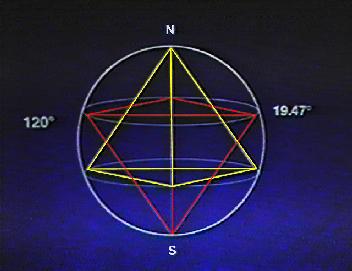
"tetrahedral latitude"
see this article by Richard C. Hoagland

Groundplane of tetrahedron, viewed from pole
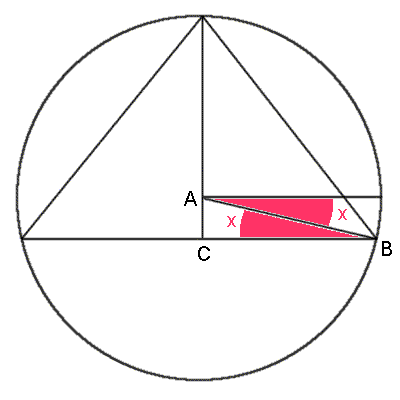

side-plane of tetrahedron, viewed from equator

Betrachten wir zunächst die Grundfläche des Tetraeders, also die Fläche, die in der Breitengradebene liegt: ein gleichseitiges Dreieck.

Davon der "Mittelpunkt" also der Schnittpunkt der Seitenhalbierenden heisse C. Einer der Eckpunkte heisse B.

Die Seitenlänge des Tetraeders sei a, dann hat die Strecke BC die Länge

|BC| = a/sqrt(3),

das folgt daraus, daß BC auf einer Seitenhalbierenden liegt mit der Länge a/2*sqrt(3) und die Stecke BC zum Rest im Verhältnis 2:1 steht (Satz über Seitenhalbierende).

Man betrachte nun das Dreieck ABC, wobei A der Mittelpunkt der ist.
Die Strecke AB ist der Radius der Kugel, also

|AB| = a/4*sqrt(6).

Die Strecke AC berechnet man mit Pythagoras:

|AB|^2 = |AC|^2 + |BC|^2

|AC| = sqrt( 1/16*6*a^2 - 1/3*a^2 ) = a*sqrt(3/8 - 1/3)

|AC| = a/sqrt(24)

Das gesuchte x ist der Winkel von der Äquatorebene zu AB:

sin x = |AC| / |AB|

sin x = a/sqrt(24) / (a/4*sqrt(6))

sin x = 1/3

[Dirk Hoppe]


A general n-dimensional solution

First, we start the calculation for n=3:
We take a equilateral triangle and put it into a circle with diameter 1. The points then have these coordinates:
x1-1/2-1/2
y0sqrt(3)/2sqrt(3)/2
Then we choose as 1st point of the tetrahedon the southpole with coordinates P0: (0, 0, -1) and move the triangle, that was positioned in the equatorial plane, up to the latitude B.

Then the moved points are
P0P1P2P3
x0cos B-1/2*cos B-1/2*cos B
y00sqrt(3)/2*cos B-sqrt(3)/2*cos B
z-1sin Bsin Bsin B
To be an equilateral tetrahedon, the central angle between southpole and one of these points on the one hand and the central angle between two neighbored points has to be the same.

Concerning, that the scalar-product of two unit-vectors is the cos() of the enclosed angle of them, so it follows

cos(P0,P1) = cos(P2,P3)

As scalar-product:

- sin B = (sin B)^2 - 1/2*(cos B)^2

From this you get as solution in sin B with 1/3 and 0.

BTW: This can be calculated in every dimension. The sin() of the central-angle between two points of equilateral n-simplex in a n-sphere is -1/n.

[idea by Horst Kraemer]