|
|
Alternative Areology and Archeology
|


|
|
News and comments 2006
News and comments 2005
News and comments 2004
- Expedition report about the petrified Cart Ruts on Malta December 16, 2004
The article sets new standards for real archeological research and analysis.
- On Proving Ancient Megalith Construction by Jim Solley.
November 28, 2004
A must read which prevails with logic and multidisciplinary thinking
over some dogmatic and primitive believe systems of Egyptology and Archeology.
All other theories, mostly invented by Egyptologists, are that much hot air,
that you could fill a giant hot air ballon to lift a whole pyramid with it!
- International Mars Conference, Ischia, September 19-23 August 21, 2004
According to the
Lectures Programme the latest results from the Planetary Fourier Spectrometer on Mars Express are discussed, which might be about the possible discovery of ammonia, formaldehyde and other gases indicating biological activity.
- New pictures from Spirit August 15, 2004


- Mars Express Spectrometer (re)discovers Ammonia (NH3) in atmosphere August 14, 2004
There are two possible sources of Ammonia which can exist only for a short time under UV-light in the atmosphere:
volcanoes or life.
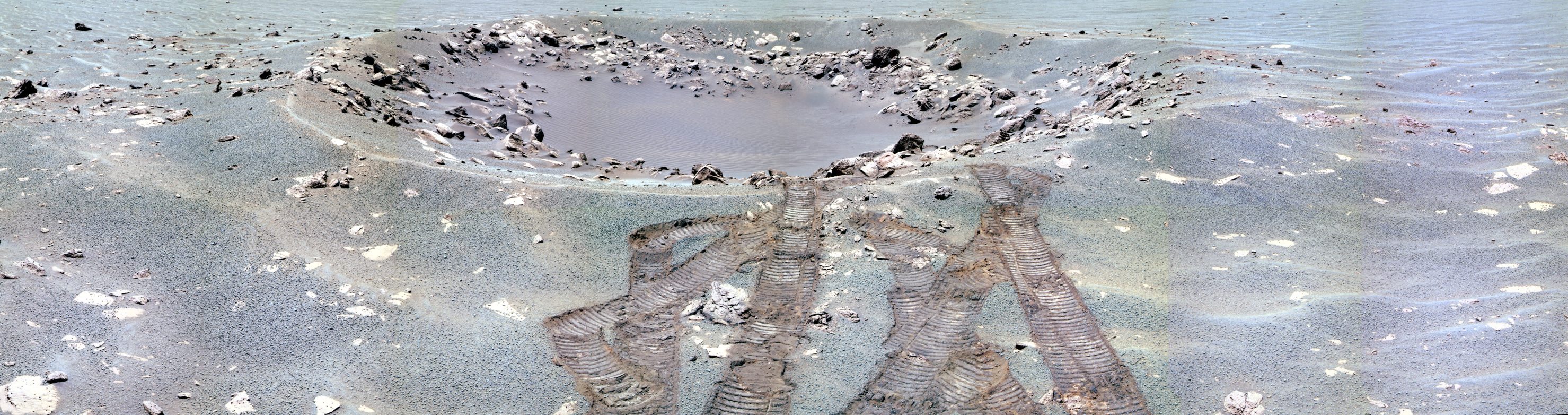
- An opportunity at Fram crater for better colors May 27, 2004
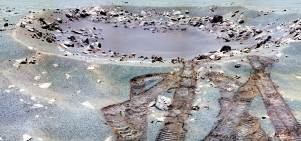
5 MB panorama,
750 kB panorama
This 6m diamater crater was taken by Opportunity's PanCam on sol 88.
A different color interpratation in JPL-corporate-identity-red
can be viewed here.
- Craterdunes May 17, 2004
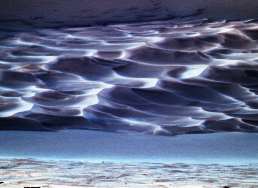
- Sensational discovery by Mars Express?
May 8, 2004
The fourier spectrometer (PFS) on board Mars Express has possibly discovered more
organic chemicals, which hint to current life as they are destroyed quickly by UV-light
in the atmosphere. Named are: formaldehyde, ammonia and benzene. Because of the
low concentration in the thin atmosphere, more measurements are required before
the PFS-Team will publish an official statement.
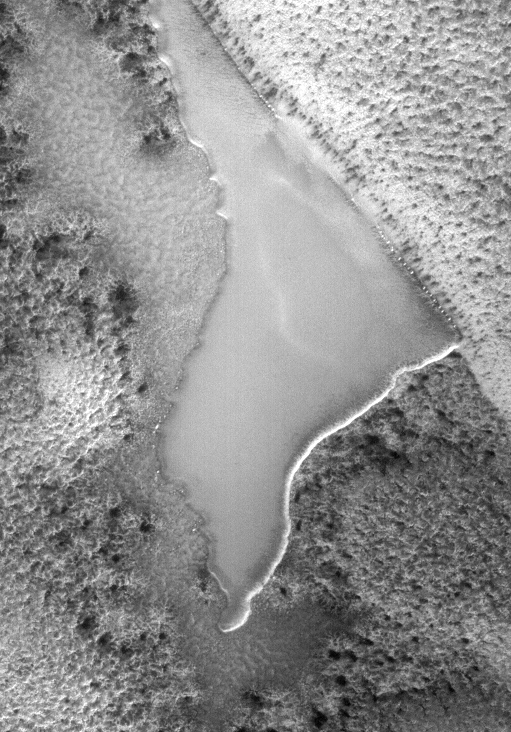
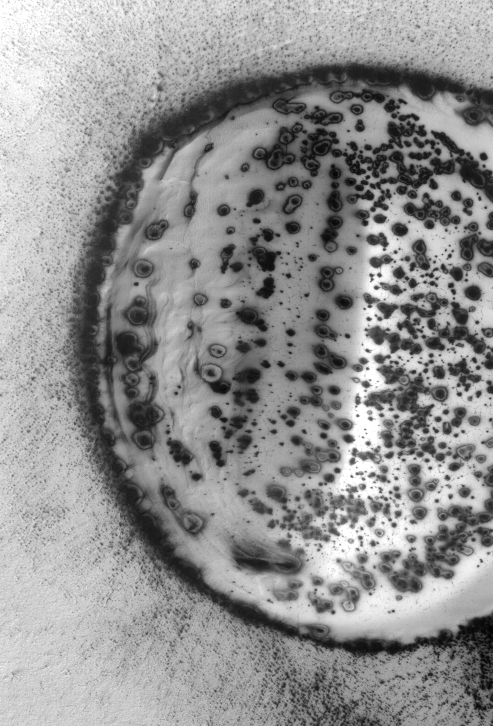
- Dried lake in the southern polar region
May 5, 2004

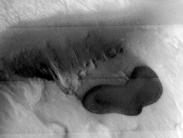
- Lake at crater bottom?
April 23, 2004
- Methane and ammonia were assumed by IR-spectra in Mars atmosphere already in 1969
after the Mariner 6 und 7 missions! March 27, 2004
Infrared Imaging Spectroscopy of Martian Volatiles
Maybe more interesting data will be found on the recently rediscovered and not until
then calibrated raw data:
1969 Mariner 7 IRS: Data Set Recovery and Calibration
- F... Fossils! March 21, 2004
NASA overlooked something important.
A tricky job. Shortly after the NASA "summercamp" a few participants visit the place,
where the space agency had hidden the test rover. They were curious, how well it
performed. As they determined, the rover had driven around the California
desert - nearby of several pieces of petrified wood.
But nobody in the control center recognized these on the views through the rover
camera. The researchers got frustrated.
[ GEO, 05/2003, "Mission Mars", p.56] |
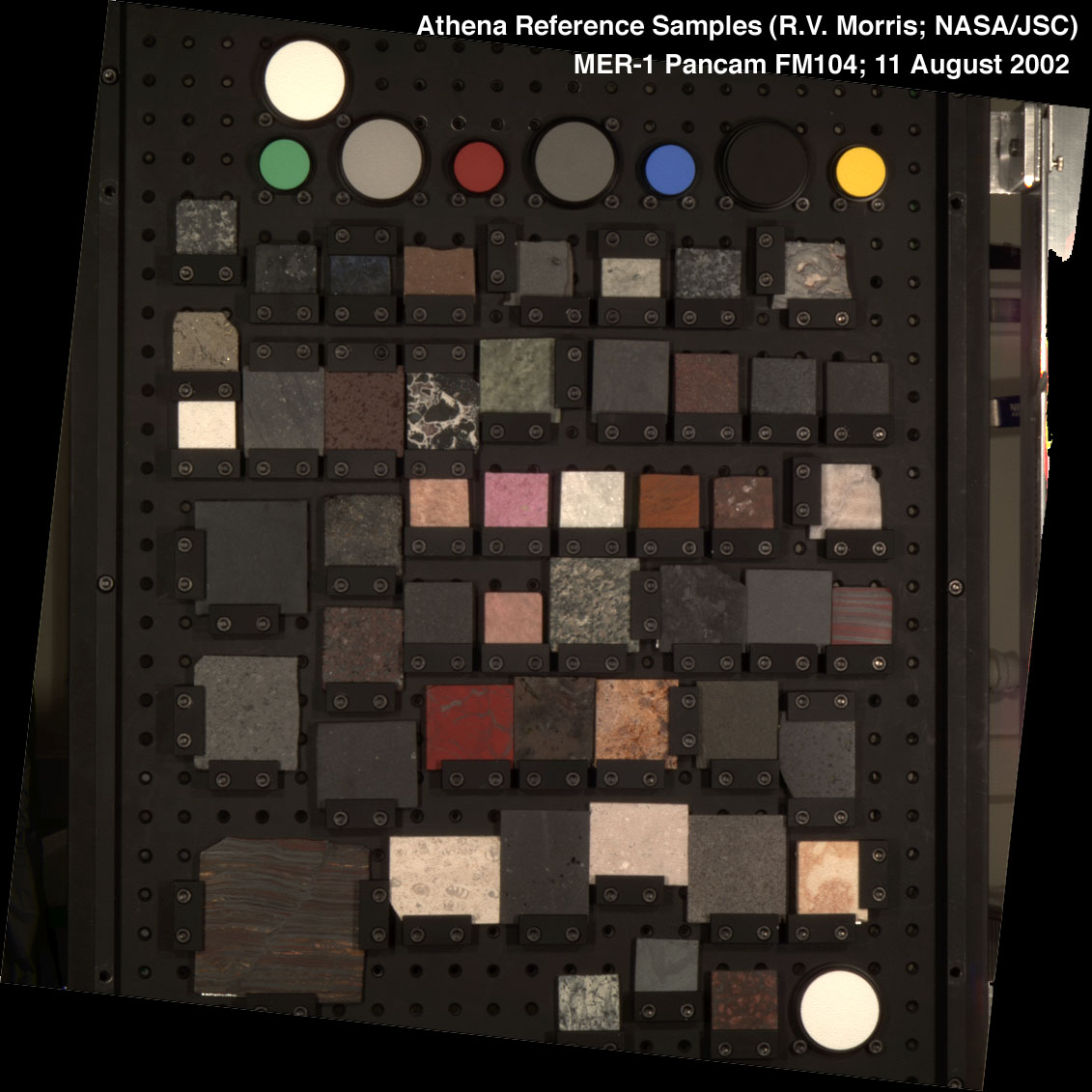
The summercamp which is mentioned here by an employee of
a NASA contract company to the GEO author is the
"FIDO" (Field Integrated Design & Operations) from 9. to 19. August
2002. JPL/NASA-engineers and scientists there simulated with an almost complete
replica Spirit/Opportunity rover the remote controlled navigation and scientific analysis:
http://fido.jpl.nasa.gov/internal.html,
http://mars.jpl.nasa.gov/mer/fido/index.html
Petrified wood like
this
or that was overlooked.
- Fossile Crinoids found by Opportunity?
March 13, 2004
- Marshrooms? March 5, 2004
- Daily automatically created Spirit & Opportunity PanCam color pictures February 13, 2004
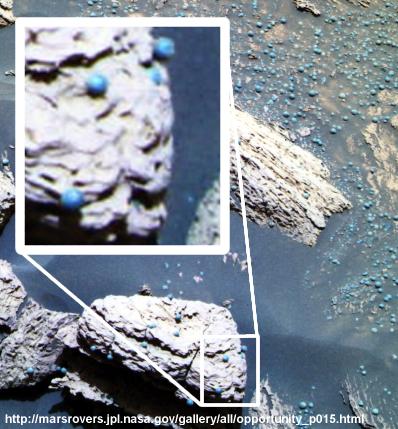
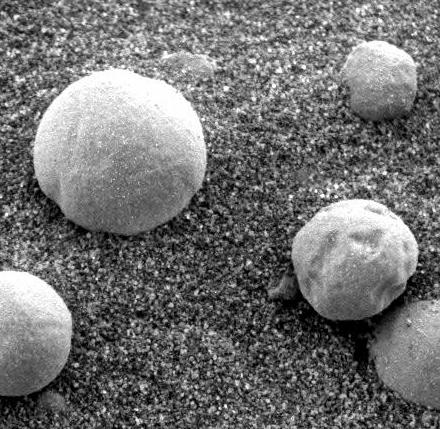
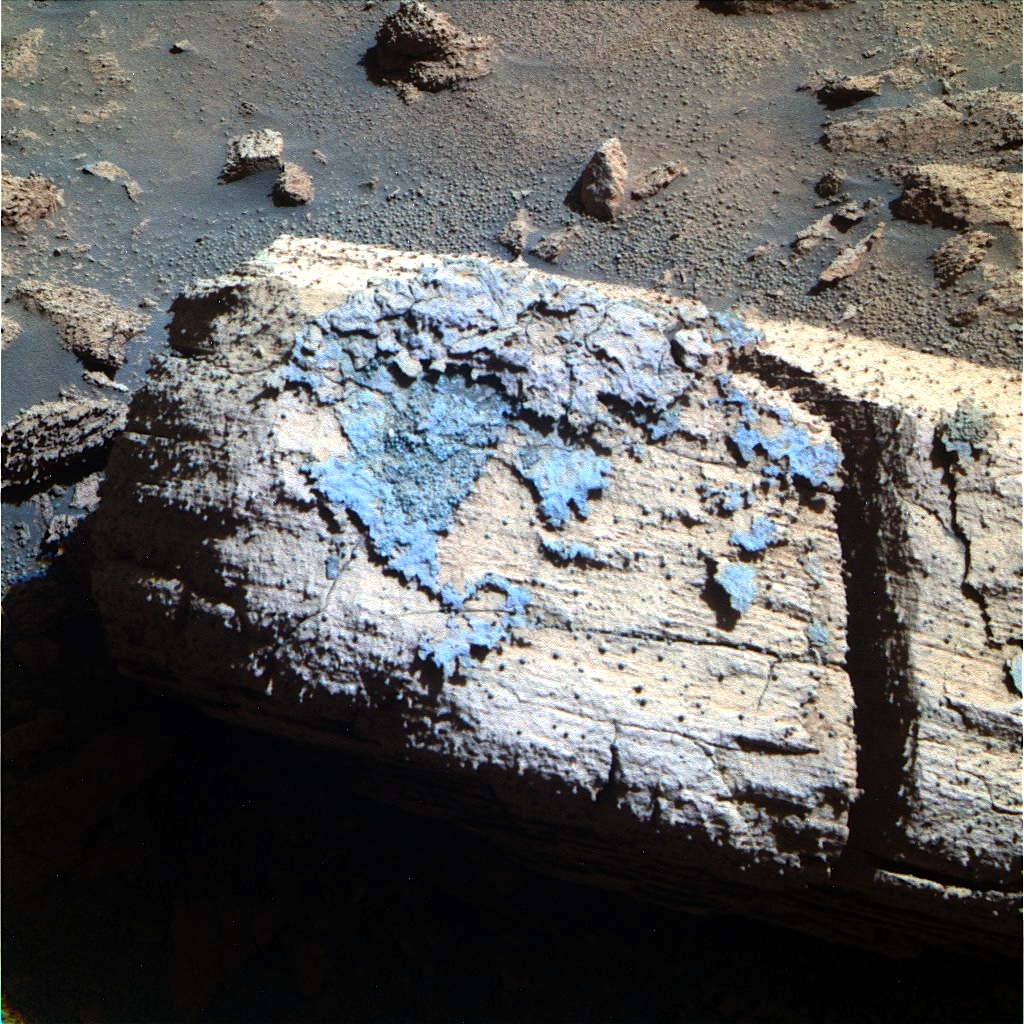
- Strange blue spheres growing on rocks!
February 8, 2004
Pic 1: Blue Spherules,
Pic 2: spherule in detail,
Pic 3: other spherule
These spheres of unknown origin are a few mm in diameter.
It's now to check if they are lifeforms or created by anorganic chemical reactions.
Original data: Opportunity Sol 13 - 15
There are similar objects on Earth known as The Moqui Marbles but these are of very hard smooth rock and not
growing out of a another rock like this one on Mars!.
-
NASA admits: IR filter used made the planet look more red.
January 29, 2004
- Mars Express HRSC shows green spots at Spirit landing site
January 28, 2004
 Similar observations are known since 1978 by Viking Orbiter 1
and were confirmed last year with THEMIS-pictures of the same region
by 2001 Mars Odyssey:
Viking 663A23,
THEMIS V04608008,
THEMIS V06468021,
THEMIS V05719013,
THEMIS V05744008
- Spirit-Lander in true colors, derived from MAESTRO-data
January 28, 2004
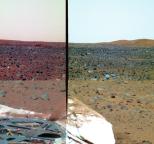
- Biological Soil Crusts: Martian soil on Earth?
January 25, 2004
- Total Success with Opportunity
January 25, 2004
Pic: Arnold Schwarzenegger at JPL
- MGS aquired with new technique image of Spirit on surface
January 24, 2004
- New pictures and data from Mars Express
January 23, 2004
More pictures on www.DLR.de.
- How to martianize the skies
January 19, 2004
- Another view on the "NASA-Colors"
January 19, 2004
- First color picture from Mars Express
January 19, 2004
Europe's Mars is sand colored.
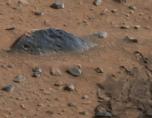
- Spirit analyzes strange shaped rock January 18, 2004
 image source
- Russian Mars Mission in 2014?
January 14, 2004
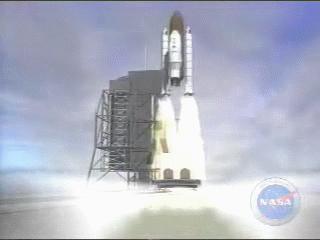
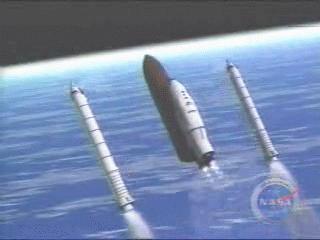
- President Bush Announces New Vision for Space Exploration Program
January 14, 2004
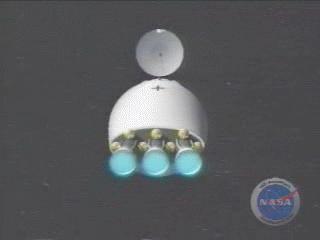
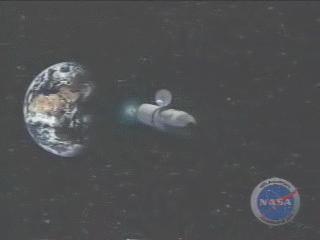
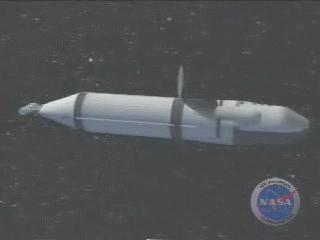
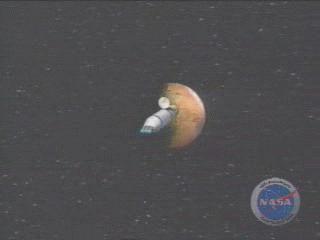
Visualisation of the Mars Reference Mission:
04,
05,
06,
07,
08,
09,
10,
11,
12,
13,
14,
15,
16
Pictures: Towards: Mars by Bob Sauls, taken from NASA-TV
- Mars in 3D
 January 11, 2004
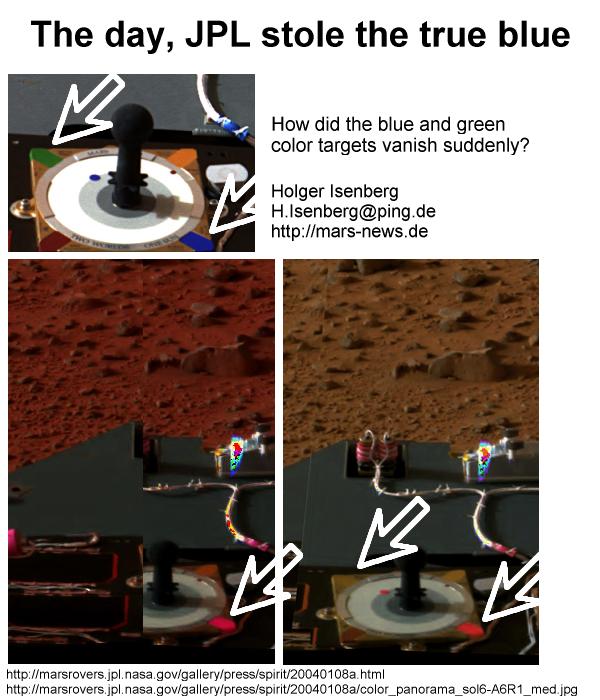
- The day, JPL stole the true blue
January 9, 2004
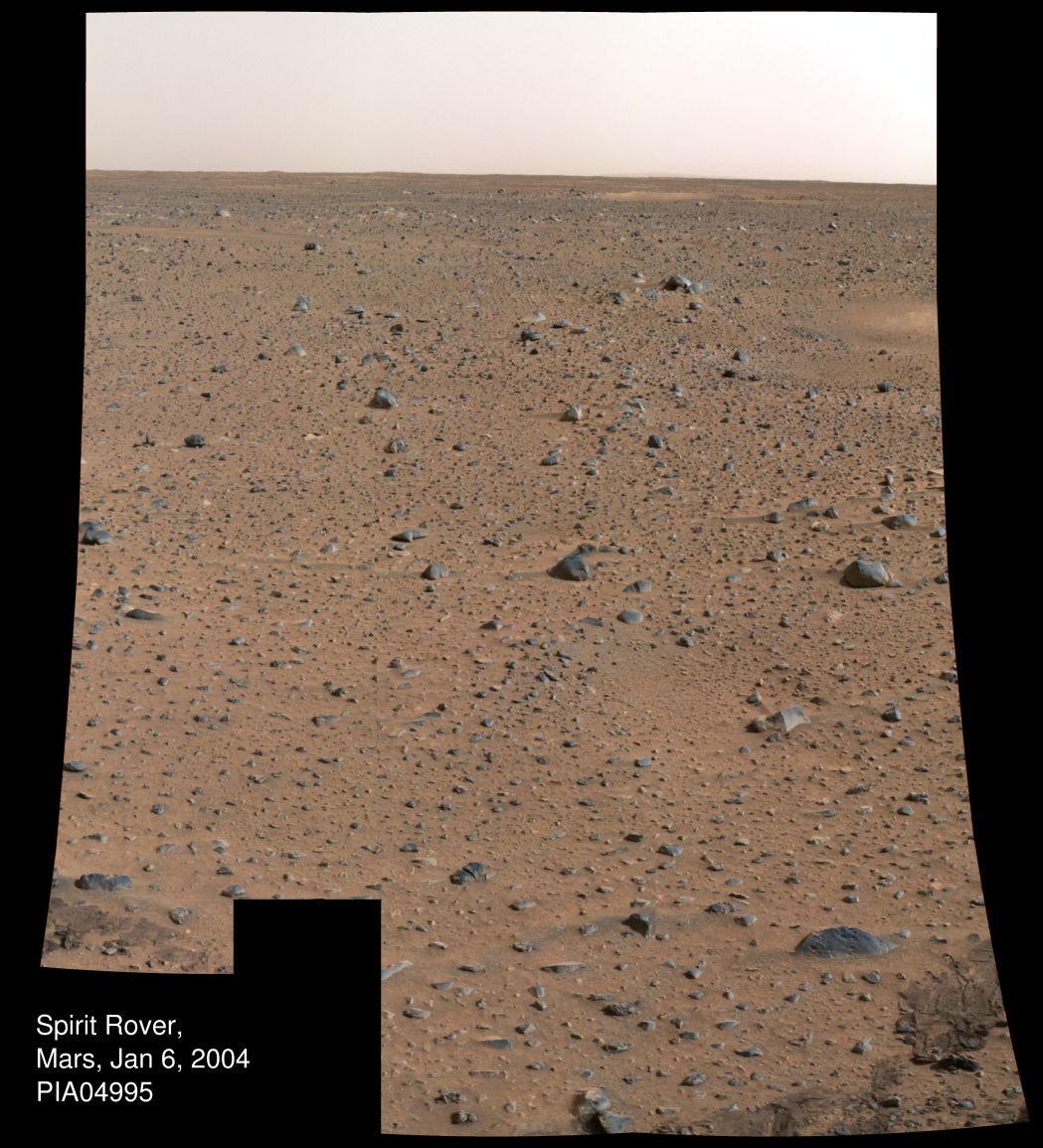
- First color picture from Spirit Rover January 6, 2004
Source: PIA04995
-
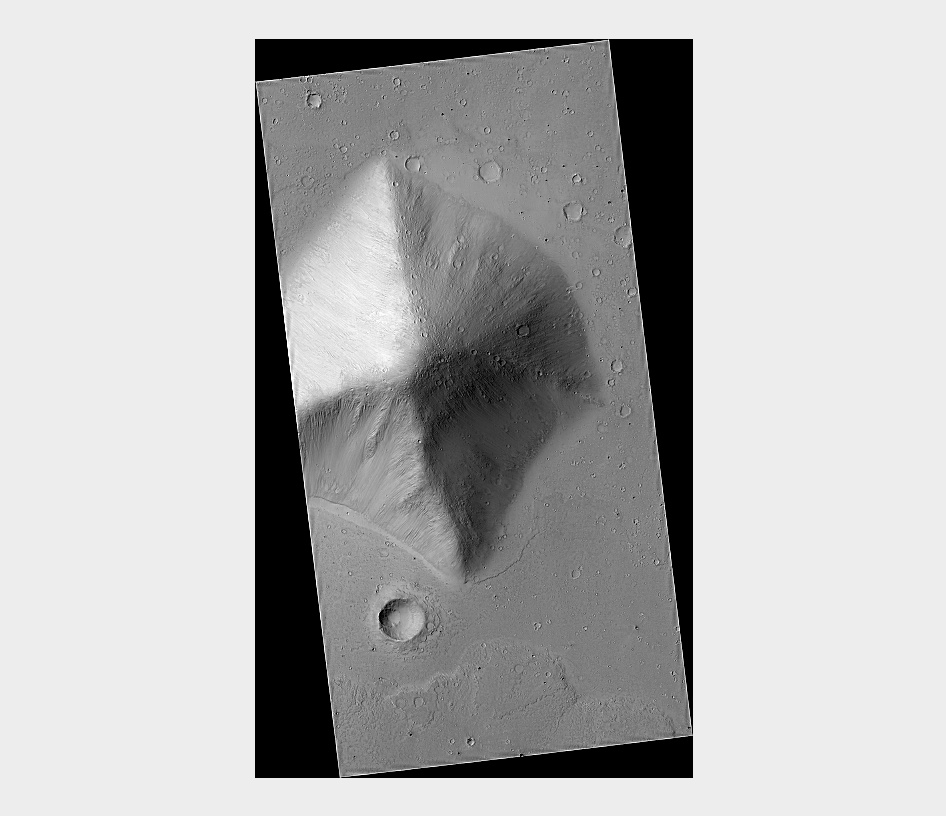
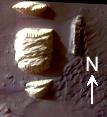 Interestingly shaped 4km large monolith in Ganges Chasma. January 4, 2004
Noteworthy are also the bright white color and the alignment towards the 4 cardinal points!
It almost looks hypo real!
data source: THEMIS V04359003
- Spirit sends first pictures from Mars surface!
January 4, 2004
spirit1.jpgspirit2.jpgspirit3.jpg
News and comments 2003
- Landing of Beagle 2 and orbit insertion of Mars Express: 12/25 3:00 UTC.
December 22, 2003
Internet Live-Stream from ESA-Controlcenter at Darmstadt:
http://esa.capcave.com
and via Astra-Digital in Europe with these parameters:
Identifier=ESA, Frequency=10.832, Polarisation=H, Symbolrate=22.000, FEC=5/6,
SID=61950, V-Pid=55, A-Pid=56, PCR-P=55, Provider=Astra, Transponder=57
News about Mars Express und Beagle 2: http://mars.esa.int
Installation of RealOne-Player for Linux:
- Beagle 2 lander successfully released from Mars Express orbiter! December 19, 2003
- Nozomi failed
(other source at isas.ac.jp) December 10, 2003
- Mars Express: First Picture from 5.5 Million Kilometers
December 3, 2003
- Mars Odyssey: interesting (almost) true color picture of Melas Chasma November 17, 2003
- Japanese Marsorbiter Nozomi (Hope)
will arrive on December 14. November 15, 2003
This probe will be the first in Mars orbit with a true-color camera.
- Do the Owls want to shut down Richard C. Hoagland? November 12, 2003
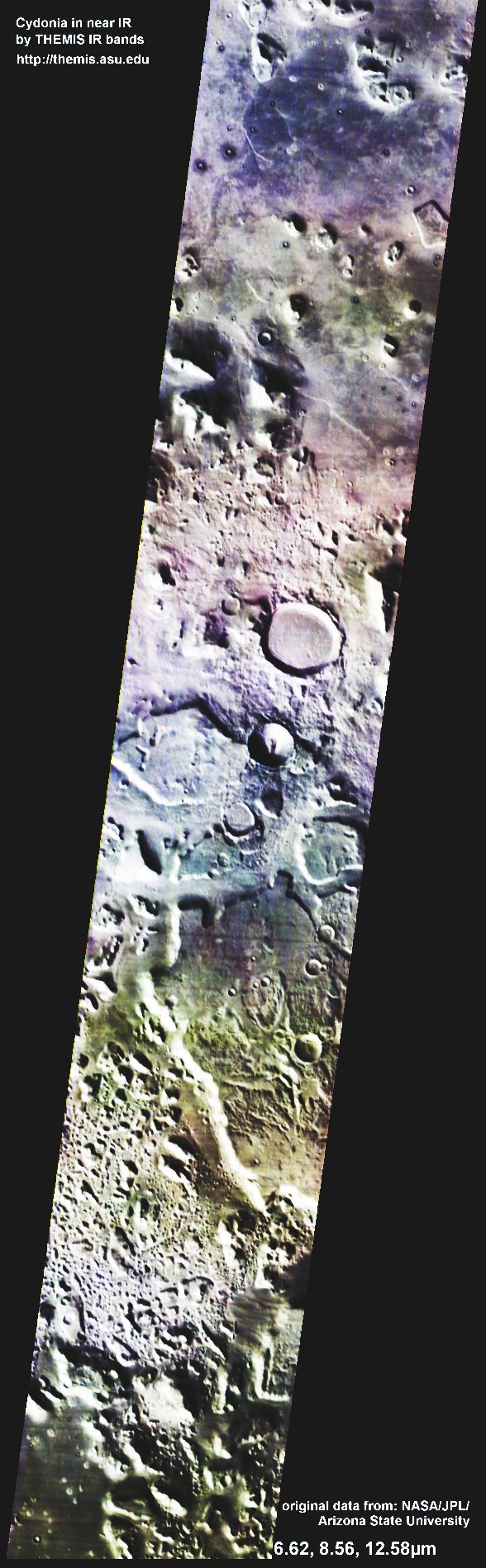
The 2002 Cydonia IR story in context.
Idolos i vacas de los collasvios. idolosivacas deloscollasvios. carnero negro. (Huaman Poma de Ayala)
- More liquid water in Martian soil than previously assumed. (automatic translation) October 28, 2003
Scientists at the DLR (German Space Agency) proved experimentally
that the Martian soil has sufficient chemically bound water,
to make live possible as in permafrost soil on Earth.
- Solving the color calibration problem of Martian lander images (Ron and Gilbert Levin)
October 11, 2003
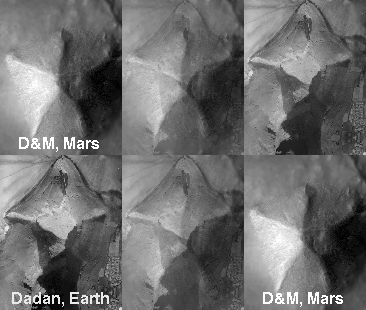
- MGS sends new detailed picture of D&M-Pyramid at Cydonia September 17, 2003
For comparison, some pictures from Iran:
Picture sources:
Persepolis and Ancient Iran, Oriental Institute, University of Chicago.
THEMIS image of Cydonia,
NASA/JPL/Arizona State University.
- Ice-Towers on Mars
August 4, 2003
Mars Global Surveyor has already taken some pictures of these ice-volcanoes (Abb.3).
- Mars Express obtained true color picture of Earth and spectrometer data
August 4, 2003
- MER-B (Opportunity) launched on July 7, 11:18pm EDT July 8, 2003
- The Race to Mars: current placings
June 18, 2003
- Surprise at Gusev Crater?
June 16, 2003
Mars Odyssey took a picture of Spirit's landing site.
- Planned arrival time of current missions
June 14, 2003
(updated on November 15, 2003)
- The first of the two Athena Mars Exploration Rovers
(MER 2003) will be launched on Tuesday 1:58 PM EDT from Cape Kennedy (aka Cape Caneveral).
June 9, 2003
Test pictures of the Panorama Camera:
The German participation on this mission:
- At 19:47 MEST Mars Express will be launched on a Soyuz-Fregat from Baikonur Cosmodrome in Kazakhstan.
June 2, 2003
The onboard Highres Stereo Camera developed by the German Institut of Space Sensor Technology and Planetary Exploration will transmit the best ever true color pictures when arriving in december.
Also transported onboard will be the Beagle 2 Lander, with life detection experiments and a color camera.
- Odyssey 2001 sends with 18m/pixel the highest resolution ever color pictures of Mars' surface!
May 1, 2003
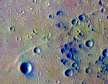
 The first 806 color pictures are now published by the THEMIS-Team
at Arizona State University on http://themis-data.asu.edu.
Some interesting examples:
V03233002 (White Rock),
V01875014,
V01657007,
V01518003,
V03149001,
V02038002,
V01751001,
V03340004,
V01812007
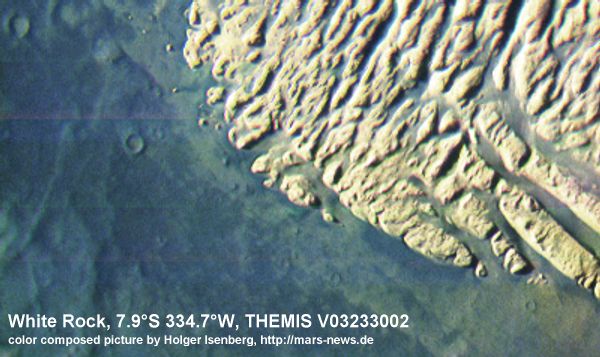
- First color picture of White Rock, a 15km longrock in Pollack Crater, presumably consisting of limestone!
April 4, 2003
A previously taken synthetic color picture from MGS,
show similar colors, where here the green color channel was "guessed" by the red and blue ones.
The new pictures shows a very bright ivory color, which would portend to limestone, if the formation
would be found on Earth.
Limestone was created on Earth by sedimentation of clam shells.
The picture was taken with the THEMIS color camera
of the Mars Odyssey 2001.
The original data: V03233002
- Sir Arthur C.Clarke is wondering about NASA according to his article in the current edition of
Aviation Week & Space Technology. March 26, 2003
Clarke: "And talking about stupidity, I feel that a current example is the refusal by everyone to
recognize that we've already discovered life on Mars.
How else can you explain the Mars Observer Camera's
M08-04688
striking resemblance to banyan trees?
I'm beginning to wonder if there is intelligent life at NASA."
- New Odyssey data show moderate radiation levels and interesting Thorium and Potassium distribution over the planetary surface March 18, 2003
The averaged radiation dose in Martian orbit ist about 440 mSv/year.
In comparison to this, the critical value for radiation exposed workers is about 500 mSv/year measured on the skin.
As a consequence, there is a radiation strain for the astronauts, but not really harmful, as it is only
2.5 times larger than in the orbit of the ISS.
- Caltech: The Martian polar caps are almost entirely water ice February 14, 2003
- LA Times: Nuclear Rocket project Prometheus to get big boost January 17, 2003
NASA Administrator Sean O'Keefe spoke in an interview with The LA Times about the
possible official announcement on 1/28 about the launch of the nuclear rocket project for
manned interplanetary space travel as the top research priority.
With that propulsion system it would be possible for humans to reach Mars in a two-month journey.
nuclearspace.com: more Information on nuclear engines
News and comments 2002
- Magnetic field of Mars satellite as strong as Earth's
December 12, 2002
Moscow, December 6, 13:35 GMT, (Itar-Tass)
Russian scientists have come to the conclusion that Phobos, a tiny satellite of Mars,
has a magnetic field as powerful as Earth.
The director of Moscow's Institute of Magnetism and Radio Wave
Propagation, Viktor Orayevsky, told Itar-Tass on Friday that a mishap
helped the discovery. The Soviet Union's probe Phobos-2 reached Mars
in March 1989, entered the orbit of Phobos and carried out for four
days measurements under a plan of the mission control center. However,
control of the probe was lost before the beginning of a main research
program, and telemetric returns from it ended up in the center's
archives as useless. It was 13 years later that scientists of the
Institute of Magnetism examined the discarded data and found out the
magnetic field of Phobos, which in only 22 kilometers in diameter, is
as strong as Earth's.
According to the scientists, this suggets more than one-third of the
satellite is made up of a magnetic substance, and in this sense it is
unique in the solar system.
History of the Space Magnetic Research Lab.
IZMIRAM Russian Academy of Sciences: Institute of Terrestrial Magnetism, Ionosphere and Radiowave Propagation
Finally, also NASA presents their first color picture from Odyssey
December 8, 2002
First color picture was shown by "Woodlock" on November 16, see below.
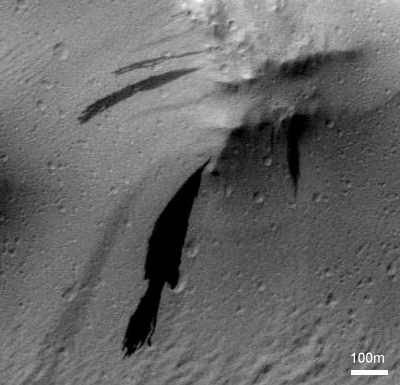
Slope Streaks on Mars: Correlations with Surface Properties and the Potential Role of Water
November 27, 2002
Previous research on this topic: Efrain Palermo, Jill England (link via the large Internet Archive: www.archive.org)
An interesting picture, showing streaks with different brightness: M18-01166
An alternative approach on the origin of Lunar and Martian rilles and craters
November 27, 2002
First color picture taken by 2001 Mars Odyssey!
November 16, 2002
For some unknown reasons, neither NASA, JPL, ASU nor AMES was capable to publish a color picture.
This picture was created by amateur areologist Woodlock
from original data of the THEMIS camera.
The crater in center has a diameter of about 19.5km.
Archeological Sites in todays Iraq
November 10, 2002
The sites look like what coming Mars Expeditions could discover...
THEMIS: Cydonia in Infrared at night (4:44 AM local time)
October 31, 2002
TransOrbital Inc. will send robot to the Moon next year
October 25, 2002
How Richard Hoagland got Hoaxed
(article by "alien54) October 12, 2002
My comment on the "real IR image" story:
As you may have read my name in the latest article on
The Enterprisemission (TEM), you might be interested in my
evaluation on the topic. As I wrote shortly after release of TEM's article "A Tale Of Two Cities",
on several discussion forums, the socalled "real IR image" was, in my estimation, a sophisticated hoax created
by some still unknown 3rd party, to discredit TEM and all other further research on the possibility
of subsurface ruins on Mars.
Alien-Bitstream in Crabwood cornfield, Hampshire, England
August 24, 2002
Methane producing microorganisms grow in simulated Martian atmosphere
August 21, 2002
"Gantenbrink-Door" in Great Pyramid will be opened on September 16. August 14, 2002
9 years after Rudolf Gantenbrink's discovery of the blocking stone
at the end of the southern shaft of the socalled Queen's Chamber by a small robot vehicle,
the mystery about this artefact with copper fittings will be solved.
With live TV coverage by National Geographic via FOX-TV, a NASA robot will peek behind the stone
with fibre optics or by drilling.
Hopefully, the German engineer Rudolf Gantenbrink will be credited for his discovery on March 23, 1993.
The Mars Gravity Biosattellite Project
August 9, 2002
A 7 weeks study of effects of 1/3g on a mice population.
25% of magnetic material in ALH84001 was produced by bacteria
August 3, 2002
An older report with photos: spacescience.com December 20, 2000
Cydonia in infrared during daylight.
July 24, 2002
Composed pseudocolor picture from 3 IR-bands.
The spectral spread is too small to use this image scientifically.
Russia wants international manned Mission to Mars in 2014
July 5, 2002
NASA cancels press conference on discovery of frozen oceans without any explanation!
May 30, 2002
Evidence of frozen oceans confirms alternative theories on Mars
May 30, 2002
Gilbert Levin already showed 25 years ago via the data from
the Viking Mission, that there is not only a sufficient amount of water in the upper soil layer, but
also at least bacteria or algae live there.
Richard Hoagland presented before this new NASA release
a theory about Mars as a former moon of the 5th Planet, which disintegrated into todays Asteroid Belt.
Mars was tidal locked in orbit of this planet, like the Moon to Earth, which deformed Mars and caused
higher water concentrations at two antipodal regions at the equator. These two regions were now confirmed
by 2001 Mars Odyssey.
The politic important issue on this new official NASA release is the now simplified and largely cost reduced
manned mission to Mars, as oxygen and hydrogen are now abundant resources on location for life-support of the
expedition crew and fuel for the return flight.
A press conference on this discovery will be shown live on the Internet
via NASA-TV on Thursday May 30, 16:00 GMT.
US National Research Council urges NASA to sent Mars astronauts only to areas with lowest possibility for life!
May 2, 2002
D&M-Pyramid and Face on picture from Mars 2001 Odyssey!
April 13, 2002
However, the on-bord camera has better capabilities. It could deliver
a true color image with at least the same resolution.
Search for spectral signatures of chlorophyll at Pathfinder site
April 4, 2002
a poster presentation on 2nd Astrobiology Science Conference at NASA AMES
Steven Spielberg to the three on ISS:
Take care of yourselves up there, and thanks for helping E.T. phone
home again and for providing celestial guidance to his home planet.
March 20, 2002
NASA scientiests published theory on Planet V between Mars and Asteroid Belt
March 20, 2002
Clear indication for chlorophyll in dark spots on Martian surface
March 18, 2002
Chlorophyll mainly absorbes red light and only relativly small amounts of blue light, which causes
lifeforms containing chlorophyll to appear as black spots in red-filtered images where in blue-filtered
ones of the same area, the objects are almost not distingishable from the soil.
This effect was discovered by Rex G. Carnes
on this MGS picture,
when he tested his new patented device to detect camouflaged military gear from plants via a spectroscopic
method on satellite images.
The discovery confirms
observation results published in September 2000
by Dr. Serguei M. Pershi, who wrote, he detected chlorophyll by analyzing color picture taken by
the Hubble space telescope.
Scientists at ESA say, these spots warrant a close lock
Picture of the same area, taken byViking 1 in 1978.
West of the MGS-picture, you can see larger darkbluegreen spots inside craters.
new Update:
If these spots consists of lifeforms, they are most probably
Cyanobacteria (Blue-Green Algae), which use chlorophyll like plants and contaminate their environment
with toxic compounds, so that other bacteria are killed in their area.
This symptom is visible, as the area around the bluegreen spots is very bright
relative to the darker surrounding soil.
Maybe the reason for the dark seeps on slopes are also cyanobacteria as
it is on Earth:
see 2nd picture from bottom on this page.
MARIE on 2001 Mars Odyssey is OK now
March 15, 2002
With MARIE the radiation dose for future manned missions can be estimated.
Mars Odyssey 2001: first scientific results: large water-ice reserves in south polor region
March 1, 2002
First images from Mars Odyssey on March 1st 7:00 PM GMT
February 27, 2002
Buzz Aldrin suggests plan to NASA for Earth-Mars cruise ships in 2018
February 7, 2002
2001 Mars Odyssey completes aerobraking
January 11, 2002
Now, scientiests try to reactivate the failed MARIE device for
measuring possible radiation hazards for forthcoming manned expeditions
on the Martian surface.
Richard C. Hoagland (Enterprisemission) & RKO Pictures: Movie project about Mars on the big screen!
January 9, 2002
This was announced on todays Art Bell - Coast To Coast AM.
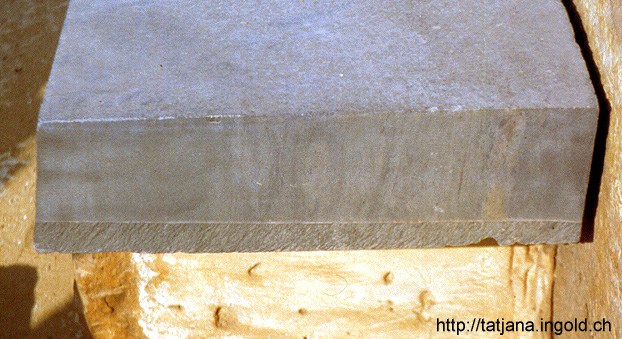
Mesopotamians made synthetic Basalt 4000 years ago
January 3, 2002
from Brookhaven National Lab & Stony Brook University, June 25, 1998
same story on BCC
original article in Science magazine
News and comments 2001
- The Observer: Pyramids made of concrete?
December 30, 2001
- Pyramid stone replicated from geopolymer concrete
December 29, 2001
- Ruins in 2200 feet deep water near Cuba! - Atlantis?
December 29, 2001
- Artificial mound Malik Shah in Iran resembles Cydonia Face 28.12.2001
If you know other than the following aerial photographs by Erich Schmidt
from 1937, please email me:
image 11g9,
image 11g8
- Sir Arthur C. Clarke asks NASA in an open letter to solve the riddle about these pictures from MGS.
November 15, 2001
- Vangelis' concert Mythodea was chosen by NASA to accompany 2001 Mars Odyssey
November 11, 2001
Vangelis was awarded by France the title of Chevalier de la Légion d'Honneur
after the performance of Mythodea at the Temple of Zeus in Athens on June 28th.
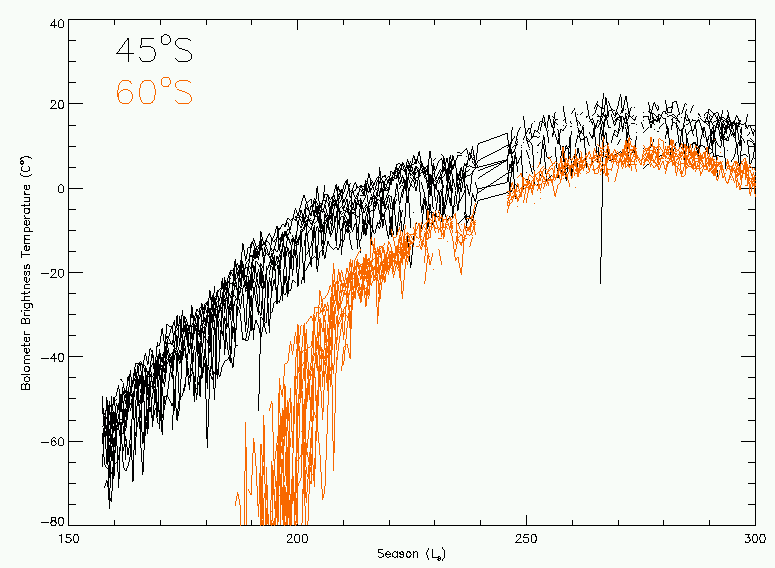
- First data from 2001 Odyssey - Surface temperatur above 0°C at 70°South!
November 1, 2001
- 2001 Mars Odyssey arrived in Orbit - first pictures announced for next week
October 24, 2001
- NASA Administrator Daniel Goldin will depart November 17.
October 18, 2001
- 2001 Mars Odyssey will reach orbit on October 24
October 17, 2001
- Hungarian scientiests found evidence of living organisms near Martian southpole
September 8, 2001
detailed Report by Eors Szathmary and Andras Horvath (PDF-Format)
- Mysterious Monolith in Abusir
with the proportions 1:4:9, known from 2001: A Space Odyssey!
detail view,
more pictures from Egypt on Tatjana Ingold's website
September 7, 2001
- New amazing Cropcircles in England
August 23, 2001
- NASA takes a 2nd view on Levin's life detection experiment data after 25 years
August 22, 2001
Information about this experiment, based on radiation measurement of release radioactive C14: Viking Lander Labeled Release Experimenter's Notebook
- Radiation detector on Mars Odyssey 2001 failed
August 21, 2001
- A new model of Mars a a former captured satellite
August 10, 2001
see also: The Exploded Planet Hypothesis
Bi-modal distribution of key features due to ancient tidal stress?
This paper is about the model of Mars as a former moon of the exploded planet
in the orbit of todays asteroid-belt. Most prominent hints for this,
are the antipodal bulges on Mars, caused by tidal forces. In these bulges,
water is present today, which causes black seeps when flowing on the surface.
These black spots are made of iron
sulphite, which is produced by the huge abundance of sulphur on the surface.
After some time, the spots bleach out, they are are oxidized to iron sulphate.
- FMARS - Simulating a Mars-Expedition in the Arctic
August 9, 2001
- Unusual hot surface temperatures August 7, 2001
20-30°C between equator and 50. latitude. More data from TES.
- Liquid Water seen today on Mars! August 1, 2001
This 1 mile wide lake of snowmelt water was found by Paul Mcleod on an MGS image of
the south polar region in Martian spring.
original image M09-01354
- 25-year-old data shows signs of life on Mars
July 28, 2001
old topic, see research by Gilbert V. Levin
more information with experiment data
- Cause for shallow craters found: Water+Lava
June 14, 2001
- Flares have been sighted on Mars
June 8, 2001
-
Arthur C. Clarke Stands By His Belief in Life on Mars
June 8, 2001
- German newspaper Die Welt:
"From Marsface to Lionshead"
May 25, 2001
The Lion/Sphinx-Thesis on the Marsface was published a few years ago by
R.C.Hoagland.
And even in the 50s, there were the Space Cadett
Sci-Fi stories about this very topic!
- New picture of Face on Mars!
May 24, 2001
- Crystal Microbes found in Meteorite
May 11, 2001
- Letters on D&M-Pyramid
April 14, 2001
- 2001 Mars Odyssey launched!
- arrival: Oct 24, 2001
April 7, 2001
- Strange crater feature found by Richard Sauder.
original image data, on M0800063
April 5, 2001
- NASA And NIMA Continue Joint Review Of Mars Polar Lander Search Analysis
March 27, 2001
- Spy Agency May Have Located Mars Polar Lander
March 20, 2001
- Discovery of recently flowing liquid on Mars!
March 20, 2001
- A Geo-Biological Mars?
March 9, 2001
- NASA Chief Administrator Dan Goldin points out need for reform in human spaceflight.
February 28, 2001
on the other side JSC Director George Abbey wants to curtail funds for manned Mars Mission
- Sir Arthur C. Clarke: "I'm fairly convinced that we have discovered life on Mars."
February 28, 2001
- More geysers and plant-like features on Mars
February 25, 2001
-
Revisiting the Mariner 9 archives
February 11, 2001
No more than 2 years ago, the original data from all Mariner 9 images,
taken in 1972, has been published on the Internet. Although, some of the images are
better than the ones from the later Viking-Orbiter and also the lighting
conditions are better than on the new MGS shots.
- Malin Space Science Systems and JPL celebrates end of MGS primary mission
with release of new pictures from Cydonia
January 31, 2001
-
The mysterious 2001-Monolith of Seattle January 2, 2001
... disapeared one day later
News and comments 2000
-
Geysers on Mars
December 22, 2000
This picture was found by John Dyck, similar images
were found several weeks ago by others on the TEM BBS.
-
Magnetic crystals in Mars meteorite made by bacteria
December 22, 2000
- DNA Test of Tutankhamun's mummy postponed by Egypt Council
December 13, 2000
- Plants live in Martian Atmosphere!
December 8, 2000
- Micro fossils in lunar rock samples
December 6, 2000
- Sedimentary Rocks on pictures from Mars Global Surveyor
December 5, 2000

- The "Age of Horus" Dawns - The Time is Now
December 3, 2000
The new article from the Enterprise Mission about our julian/gregorian calendar and its connection to Sirius in the year 2000:
Part 1,
Part 2,
Part 3,
Part 4,
Part 5, Part 6
see also: New Year's Age of Horus by Daniel Perez
- The public gets slowly prepared for the truth: Dried-up sea beds found on Mars
December 3, 2000
- NASA to Announce Major Mars Discovery on Dec.7
December 2, 2000
- Gil Levin's Life detection experiment dismissed again for Mars-Mission
December 2, 2000
- Giant lichens or fungus on Mars:
original picture,
fibonacci branching marked
(URL now correct) October 15, 2000
info about Fibonacci branching (points to life)
- Russian scientist finds organic chlorophyll pigments via pictures from Hubble September 27, 2000
- The Face Image in a Different Light August 16, 2000
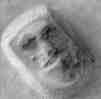
© Mark Kelly
| |
- Archeologists must rethink their theory about the first steps toward
culture and art. August 7, 2000
In Anatolia, a 11000 year old temple was found!
Article from Bild der Wissenschaft 8/2000:
The oldest temple of the World,
The first paleolithic settlement
- NASA discusses again 20 year old data from Viking Labeled Release Life Detection Experiment August 4, 2000
- German newspapers debunking the Cropcircle-Mystery July 7, 2000
They say: Roebucks rotating in circles around does caused them.
- Liquid water on Mars June 24, 2000
Since almost 20 years, scientific reports were published about liquid Water on Mars:
-
Major Mars Announcement From NASA? June 20, 2000
NASAwatch.com-Editor's note: 3:50 PM 19 June: Word has it that NASA recently briefed the
White House on a potential major discovery on Mars. An announcement of some
sort is rumored to be planned for next week and that it involves Mars Global
Surveyor.
- Ancient City found, irradiated from atomic blast June 9, 2000
- New propulsion system: 2 month journey to Mars! June 5, 2000
- Beagle 2, the very next Lander on Mars on Dec 26, 2003 May 23, 2000
- Old Data Holds New Hope for Life on Mars
19.May 2000
Circadian rythm of Mars-bacteria found?
- New images from Mars Global Surveyor 8.May 2000
Use my MOC-Finder to search the image database.
- Mystery balls fall from the sky 2.May 2000
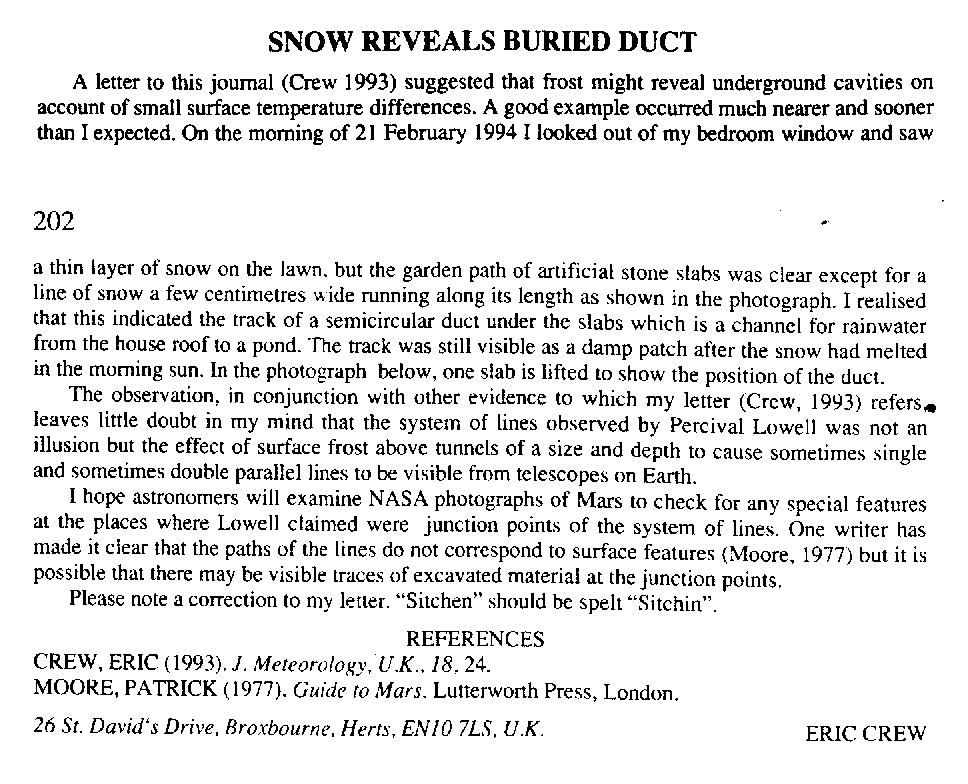
- Lowell's Channels confirmed by MGS 21. Mar 2000

© Terry James
- Brian De Palma's new movie
Mission To Mars: Its background story is stranger than fiction.
Just count together
one,
two,
three,
and four.
(note Astronaut Story Musgrave's cameo appearance in the movie)
15.Mar 2000
- Dr.Ellmann found traces of ancient planetary collision with Earth! 3.Mar 2000
- Europa: Landen verboten!
21.Feb 2000

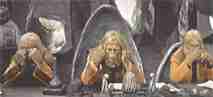
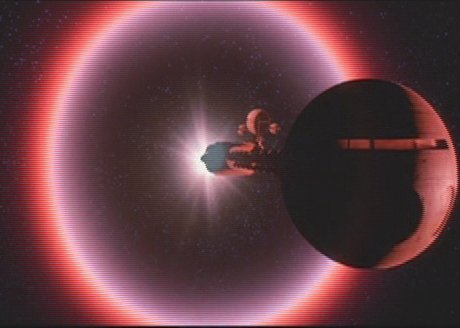
Images Courtesy of Turner Entertainment Co. / Time Warner
- Reports about falling ice from clear sky, published in 1919 10.Feb 2000
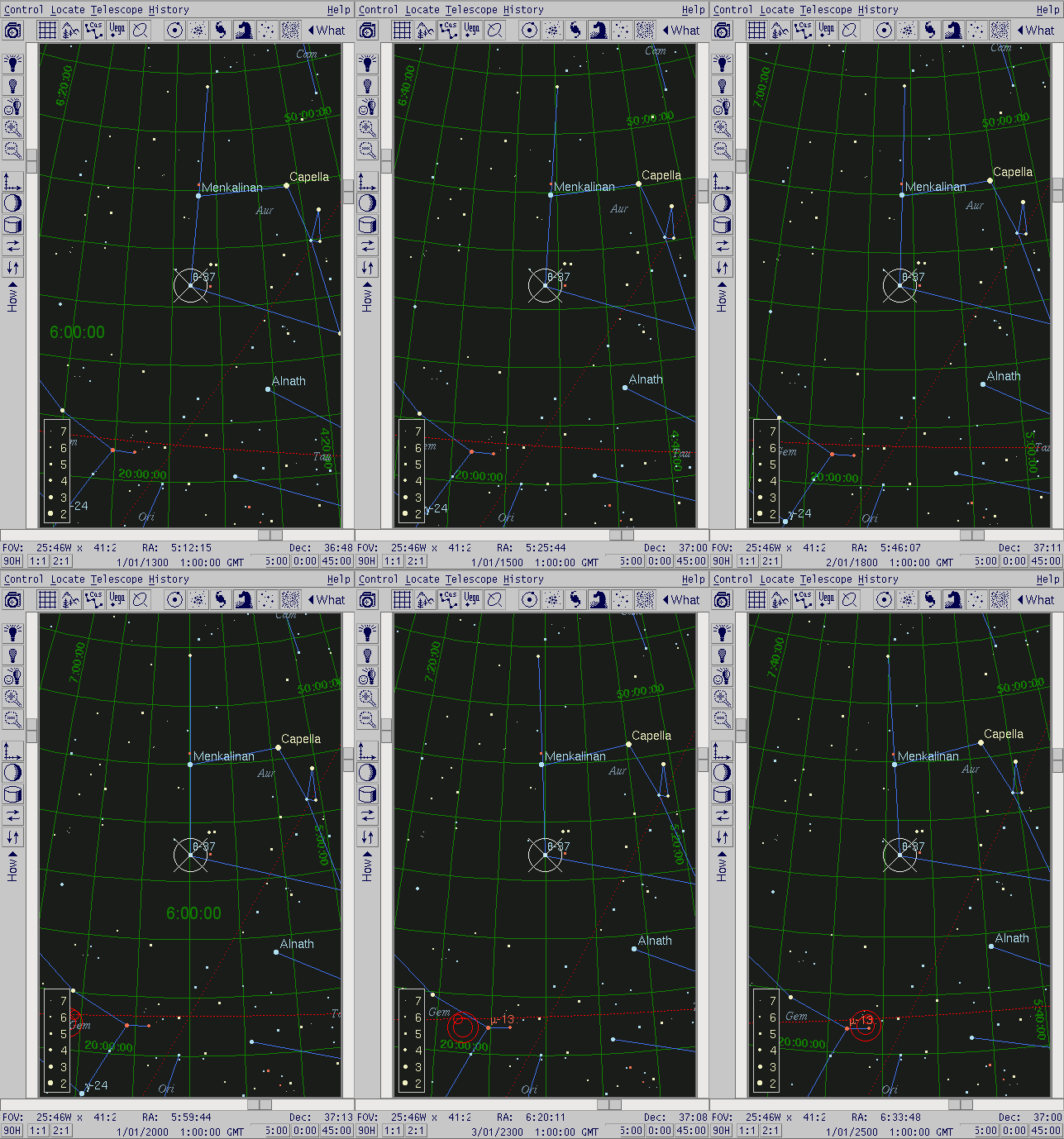

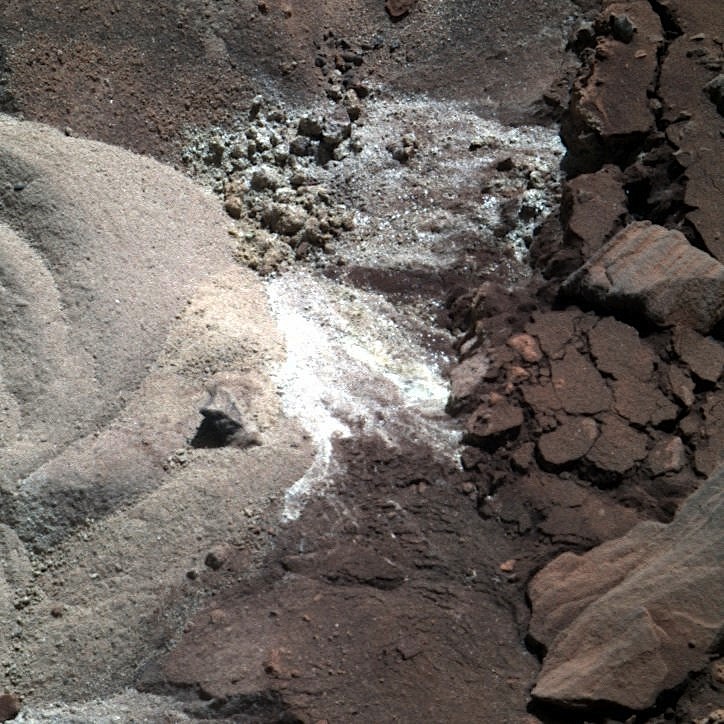
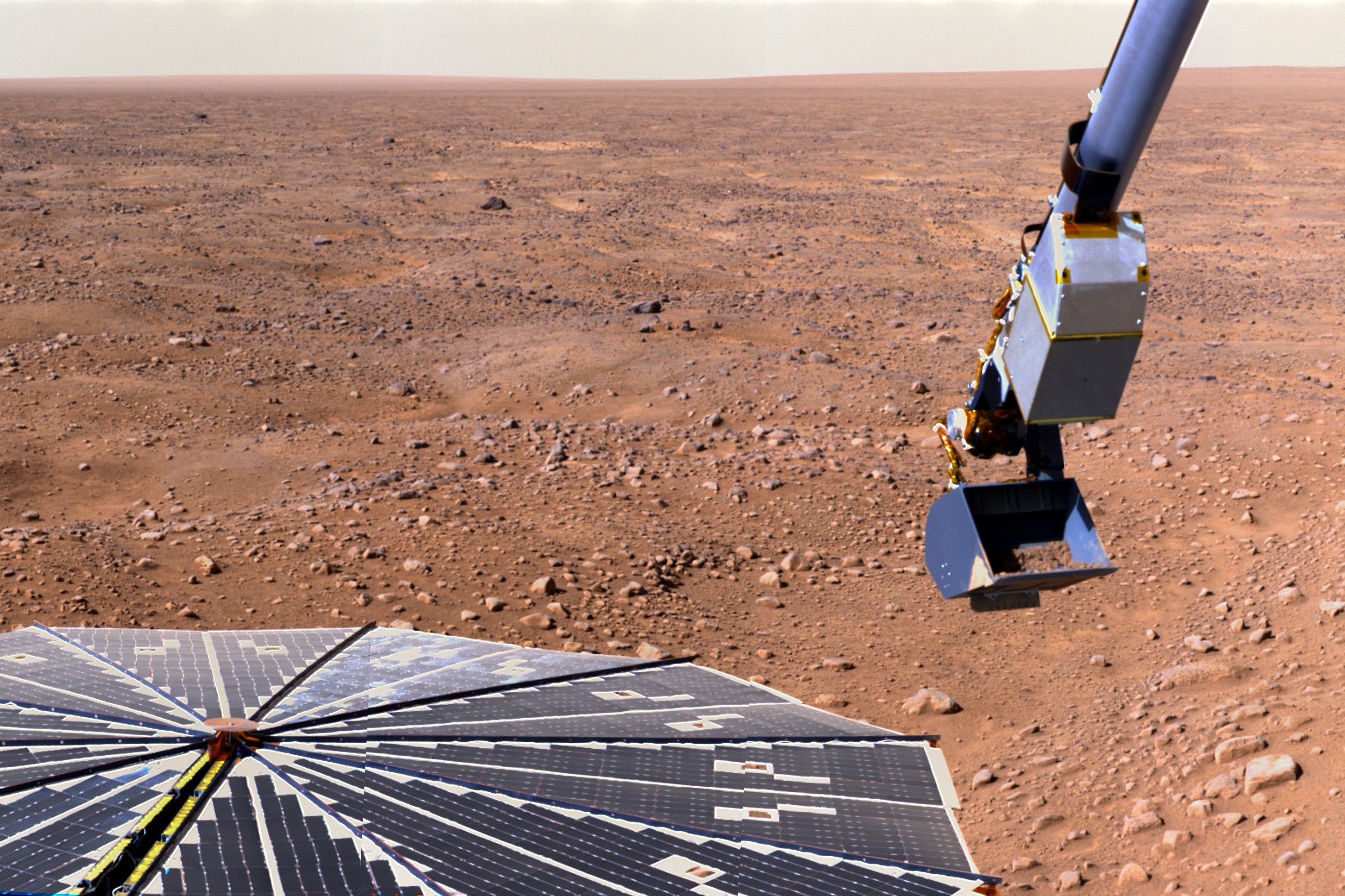
 Spirit, Sol 960.
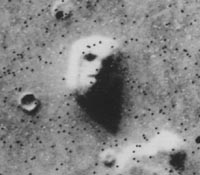
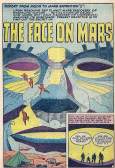 In 1947, 29 years before the Face on Mars was photographed by Viking Orbiter 1,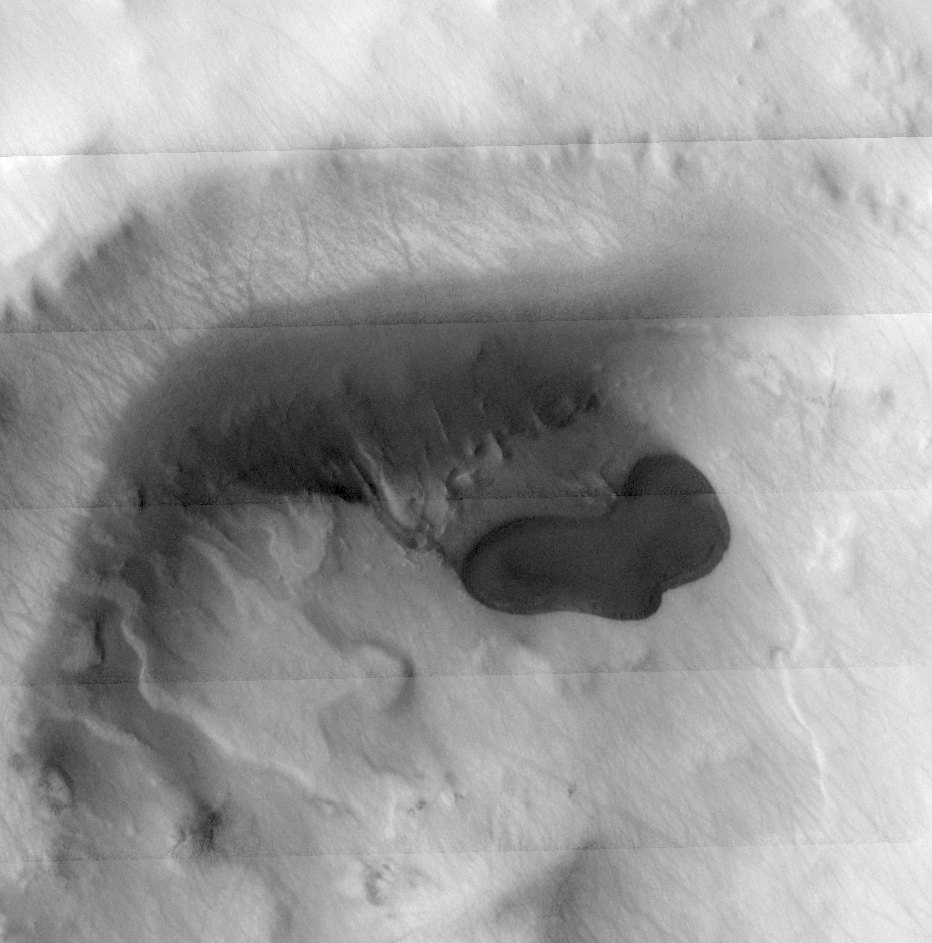
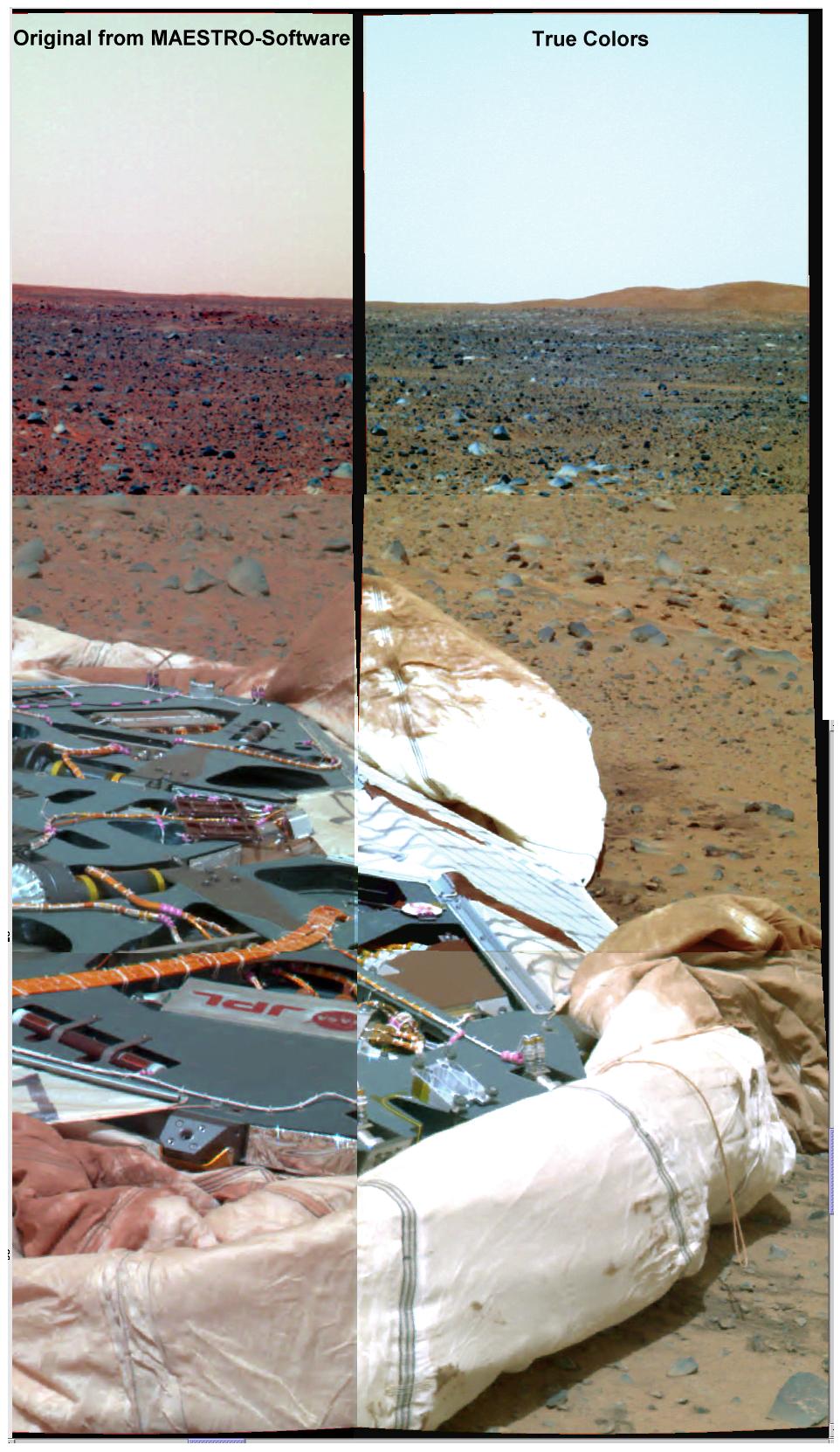
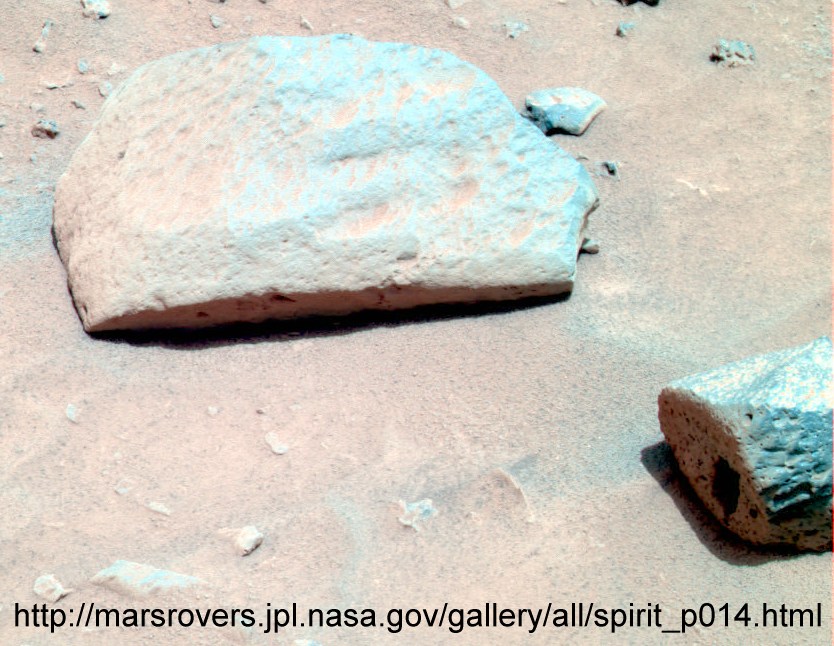 image source

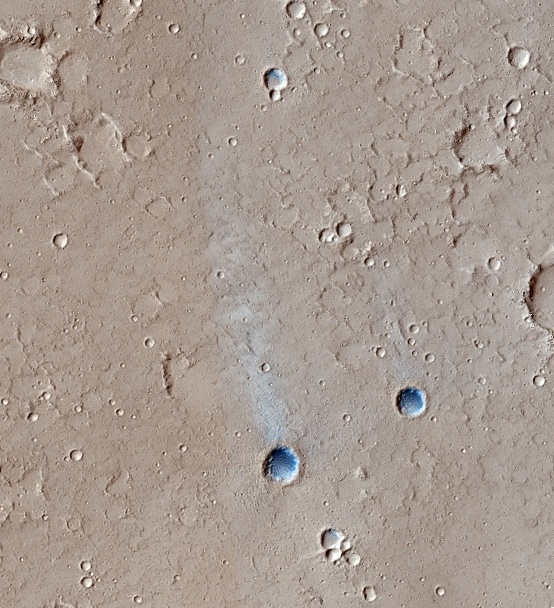

 Temperature data from early morning infrared images (THEMIS-IR)
indicate cave entrances,
Temperature data from early morning infrared images (THEMIS-IR)
indicate cave entrances,